logo

Détails des produits

Created with Pixso. Maison Created with Pixso. Produits Created with Pixso.
compas gyroscopique optique de fibre
Created with Pixso.

High Precision Fiber Optic Gyroscope ±240°/s with Low Noise 0.8°/h for EO Payload UAV Stabilization

High Precision Fiber Optic Gyroscope ±240°/s with Low Noise 0.8°/h for EO Payload UAV Stabilization

Nom De Marque: Firepower
Numéro De Modèle: MFOG-910
Nombre De Pièces: 1
Prix: 700$
Conditions De Paiement: LC, D/A, D/P, T/T, Western Union
Capacité à Fournir: 500 / mois
Informations détaillées
Lieu d'origine:
Chine
Taux angulaire maximum:
± 240°/s
Stabilité du biais:
≤ 0,8°/h
Remplaçabilité zéro biais:
≤ 0,8°/h
Cefficient de marche aléatoire:
≤ 0,02°/√h
Tension d'alimentation:
+5V
Type de sortie:
Analogique
largeur de bande:
≥1000Hz
Dimension:
82 mm × 82 mm × 19,5 mm
Détails d'emballage:
BOÎTE+Éponge
Capacité d'approvisionnement:
500 / mois
Mettre en évidence:

high precision fiber optic gyroscope

,

fiber optic gyro UAV stabilization

,

low noise fiber optic gyroscope

Description du produit
High Precision Fiber Optic Gyroscope ±240°/s with Low Noise 0.8°/h for EO Payload UAV Stabilization

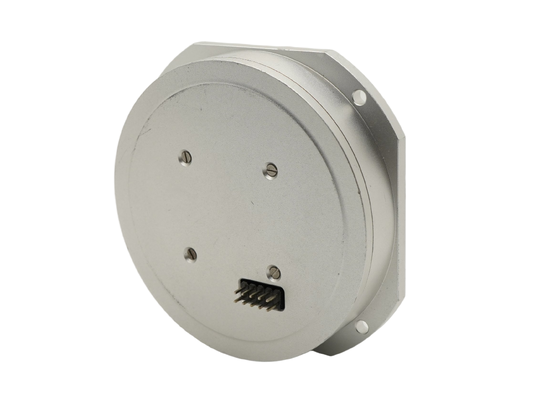
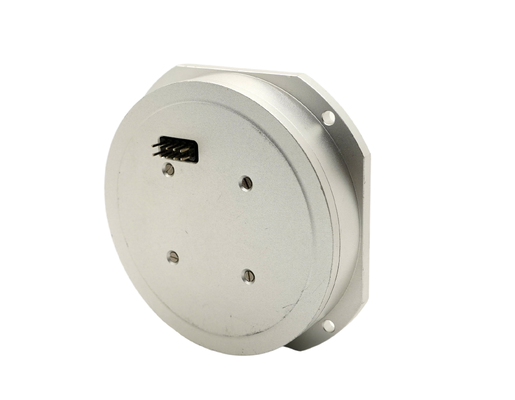
The MFOG-910 is a fully integrated micro-nano fiber optic gyroscope, completely compatible with Fizoptika VG910, offering superior performance in compact dimensions (82*82*19.5mm). It achieves ±240°/s angular rate range, 3dB bandwidth ≥1000Hz, and power consumption ≤1.5W. With no moving parts and high impact resistance ≥1500g, it is ideal for satellite attitude control, UAV navigation, autonomous robots, and marine vessel stabilization.

Product Composition

The product is mainly composed of the following components:

  • Optical path assembly
  • Detection and control signal circuit board
  • Optical fiber ring skeleton, shell and other structural parts

Technical Specifications
ParameterPerformance Indicators
Range (°/s)±240
Scale factor (mV/°/s)47±5
Scale factor nonlinearity (ppm)≤1000
Zero-bias stability (10s, 1σ, °/H)≤0.8
Zero-bias repeatability (1σ, °/H)≤0.8
3dB Bandwidth (Hz)≥1000
Random walk (°/√H)≤0.02
Power supply (V)5±0.25±12
Power Consumption (W)≤1.5
Impact (g)≥1500
Acceleration (g)≥70
Life (years)≥15
MTBF≥100000
Outline Drawing
High Precision Fiber Optic Gyroscope ±240°/s with Low Noise 0.8°/h for EO Payload UAV Stabilization 0
Applications

The MFOG-910 fiber optic gyroscope is widely used in navigation, stabilization, and attitude measurement systems.

  • Unmanned Aerial Vehicles (UAVs)
  • Autonomous navigation systems
  • Marine navigation and stabilization
  • Robotics and intelligent vehicles
  • Antenna stabilization platforms
  • Electro-optical tracking systems
  • Inertial navigation systems (INS)
  • Unmanned ground vehicles (UGV)
  • Industrial motion control systems
Fizoptika VG910 Replacement

The MFOG-910 is designed to provide equivalent or superior performance compared to the Fizoptika VG910 fiber optic gyroscope.

  • Comparable bias stability and random walk performance
  • Compatible angular rate measurement range
  • Compact and lightweight structure
  • Improved supply stability and reliability
  • Cost-effective alternative solution

This makes the MFOG-910 an excellent choice for customers seeking a reliable replacement for Fizoptika VG910 in inertial navigation and stabilization applications.

MFOG-910 vs VG910H1 Comparison
ParameterVG910H1 Fiber Optic GyroscopeMFOG-910 Micro-Nano Fiber Optic Gyroscope
Angular Rate Range (°/s)250±240
Bias Stability (RMS, °/h)1≤0.8
Angle Random Walk (°/√h)0.015≤0.02
Bandwidth (kHz)1≥1
Scale Factor Stability / Repeatability (RMS, %)0.02≤0.1
Start-up Time (s)0.03Fast start
Power Consumption (W)0.5≤1.5
Dimensions (mm)82 * 82 * 2082 * 82 * 19.5
Weight (g)150≤150
Operating Temperature (°C)−40 ~ +70−40 ~ +70
Storage Temperature (°C)−55 ~ +85−55 ~ +85
Vibration (RMS, 0.02-2 kHz, g)3020
Shock (g, 1 ms)1200≥1500
MTBF (20°C)100000 h≥100000 h
Lifetime15 years≥15 years
Frequently Asked Questions
What is a fiber optic gyroscope?
A fiber optic gyroscope (FOG) is a high-precision angular rate sensor based on the Sagnac effect. It measures rotation by detecting the phase difference between two beams of light traveling in opposite directions inside a fiber coil. FOG sensors are widely used in inertial navigation systems, UAVs, robotics, and stabilization platforms.
Can MFOG-910 replace the VG910H1 fiber optic gyroscope?
Yes. The MFOG-910 micro-nano fiber optic gyroscope is designed to provide comparable performance to the VG910H1. It features similar angular rate range, bandwidth, size, and environmental specifications, making it suitable as a replacement in many inertial navigation and stabilization systems.
What are the advantages of fiber optic gyroscopes?
Fiber optic gyroscopes provide several advantages compared with mechanical gyroscopes and MEMS sensors:
  • No moving parts
  • High reliability and long service life
  • High precision and low drift
  • Strong resistance to vibration and shock
  • Wide operating temperature range
These characteristics make FOG sensors ideal for navigation and guidance applications.
What applications use fiber optic gyroscopes?
Fiber optic gyroscopes are widely used in:
  • UAV and drone navigation
  • Inertial Navigation Systems (INS)
  • Electro-optical stabilization platforms
  • Antenna stabilization systems
  • Autonomous vehicles and robotics
  • Marine navigation systems
  • Aerospace guidance systems
Why choose fiber optic gyroscopes for UAV navigation?
Fiber optic gyroscopes offer several advantages for UAV systems:
  • High precision attitude measurement
  • Fast response and high bandwidth
  • Excellent vibration resistance
  • Long-term stability during flight
These features make FOG sensors ideal for drone flight control and navigation systems.
How do fiber optic gyroscopes compare with MEMS gyroscopes?
Fiber optic gyroscopes generally provide:
  • Higher accuracy
  • Lower drift
  • Better long-term stability
MEMS gyroscopes are usually smaller and lower cost but are often used in lower-precision navigation systems.